2026 Spirit of Service Awards finalists
Congratulations to the finalists of the 2026 Spirit of Service Awards!
The 2026 Spirit of Service Awards finalists represent outstanding initiatives delivering meaningful change across the Australian and ACT public sector.
We look forward to celebrating their achievements and announcing this year’s winners at the Spirit of Service Awards gala on 5 November at the National Arboretum Canberra.
Voting for the 2026 CSC People’s Choice Award has now closed. Thank you to everyone who cast their vote and helped recognise the exceptional work of our finalists. Proudly sponsored by Commonwealth Superannuation Corporation (CSC), the People’s Choice Award winner will also be named on the night.
The 2026 Spirit of Service Awards are proudly supported by


Explore the 2026 Spirit of Service Awards finalists
COLLABORATION CATEGORY

Development and Rollout of Mandatory National Child Safety Training for the Early Childhood Education and Care sector under the National Quality Framework
Australian Government Department of Education, Queensland Government Department of Education, Australian Centre for Child Protection, Adelaide University
The development and rollout of mandatory National Child Safety Training is a collaboration between the Australian Government Department of Education, Queensland Department of Education and the Australian Centre for Child Protection, Adelaide University, on behalf of all state and territory governments to deliver nationally consistent, evidence-based child safety training for the early childhood education and care (ECEC) sector under the National Quality Framework. The initiative has replaced a fragmented, jurisdictional approach with a single, credible national framework that strengthens child safe culture, improves workforce capability and confidence, and will help those working in ECEC build safe, inclusive and responsive environments.
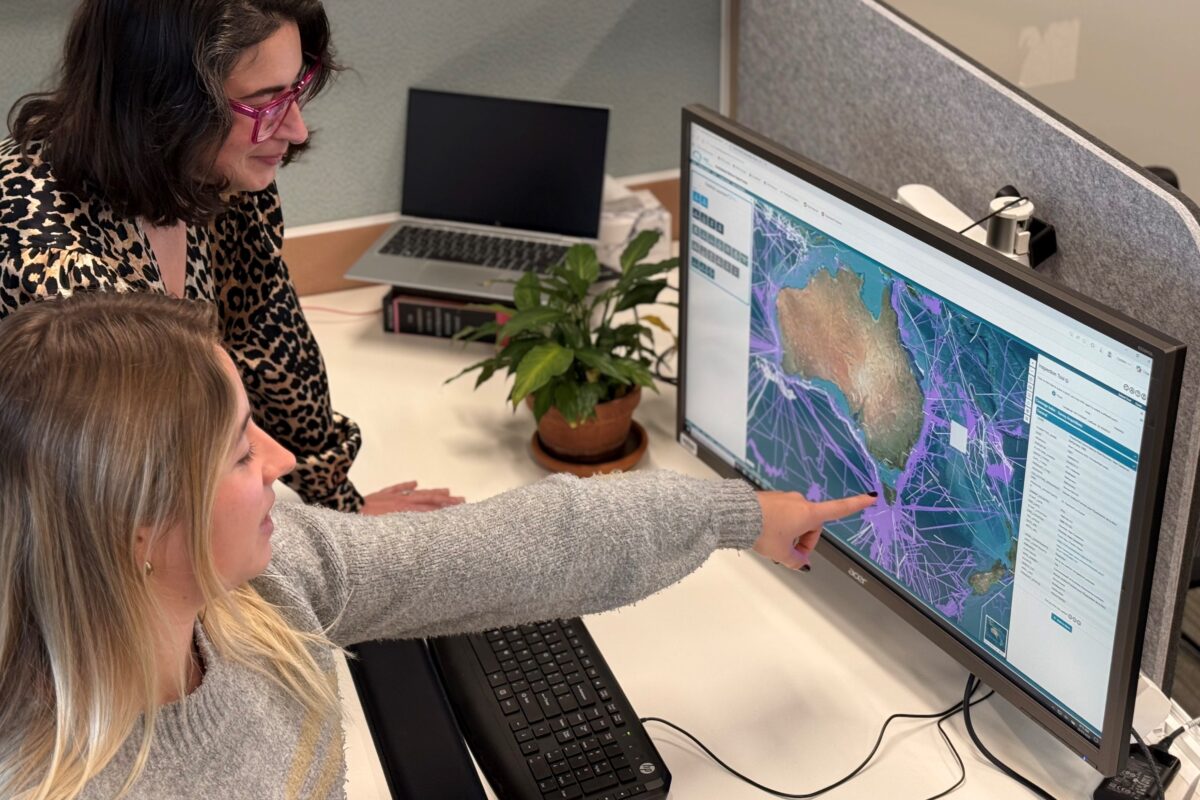
AusSeabed: Mapping Australia’s Seabed, Together
Geoscience Australia, Australian Hydrographic Office, Commonwealth Science and Industry Research Organisation (CSIRO)
AusSeabed is Australia’s national seabed mapping coordination and stewardship initiative, led by Geoscience Australia with CSIRO, the Australian Hydrographic Office, Australian Antarctic Division and Australian Institute of Marine Science. Bringing together more than 300 government, research and industry organisations, it aligns how seabed data is collected, quality assured, published and reused. Through collaboration, open access and public value, AusSeabed provides trusted seabed data that supports evidence-based decisions in environmental management, maritime safety, offshore energy, climate adaptation and national security. By turning fragmented information into a coherent national asset, AusSeabed strengthens public sector collaboration and helps sustainably grow Australia’s blue economy.

Collaborating with domestic and international industry, governments and regulators to decommission a remote, deep sea oil and gas facility.
Department of Industry, Science and Resources
After an oil and gas company entered liquidation, in an unprecedented move, the department stepped in to manage the abandoned, significantly deteriorated, unsafe, Northern Endeavour vessel and oil wells, 550 km northwest of Darwin in the Timor Sea. Limited domestic decommissioning capability and a complex regulatory environment, necessitated collaboration with Australian and international governments, regulators, industry and technical experts. The result was the triumphant disconnection of the vessel from the oil wells after 26 years, improving its safety and degraded condition and the international voyage to Denmark via Singapore for recycling. This success was achieved while protecting workers and the environment.

Share by default – health information when and where you need it
Department of Health, Disability and Ageing, Australian Digital Health Agency
The Modernising My Health Record – Sharing by Default program exemplifies outstanding collaboration across government and the health sector. It brought together the Department of Health, Disability and Ageing, the Australian Digital Health Agency, state and territory jurisdictions, and pathology and diagnostic imaging stakeholders to improve the availability of health information in My Health Record for consumers and healthcare professionals. This was not routine inter-agency engagement. It was a complex, sustained and nationally significant collaboration focused on solving a challenge that affects the quality, safety and continuity of care for Australians. By making health information available when and where it is needed, the program is supporting safer care, better care coordination and improved health outcomes for Australians.
COMMUNITY ENGAGEMENT

Centrepay Reform
Services Australia, Financial Rights Legal Centre, Economic Justice Australia
Services Australia commenced work to reform Centrepay in 2024 in response to concerns about financial harm and the need for stronger customer protections. The Centrepay Peak Advisory Reference Group was established to provide advice and engage in the co-design of reform. Through engagement with community advocates, customers, businesses and across government, the agency adopted a transparent, collaborative approach. Proposed changes were co-designed through ongoing consultation, with customer, community and stakeholder insights shaping the design at every stage. Centrepay Reform has transformed a long-standing bill paying service through community engagement and customer focused co-design, strengthening safeguards and protections for customers while ensuring the program remains fit for purpose.

Designing Culturally Safe Aged Care Homes for Aboriginal and Torres Strait Islander People
Department of Health, Disability and Ageing, Kaunitz Yeung Architecture
Designing Culturally Safe Aged Care Homes for Aboriginal and Torres Strait Islander People was developed in genuine partnership with Aboriginal and Torres Strait Islander communities, Elders and sector stakeholders. It supports aged care providers, designers and architects to create culturally safe, trauma-aware environments that strengthen connection to Country, culture and community. Shaped through extensive engagement across Australia, the initiative embeds Aboriginal and Torres Strait Islander voices at every stage and addresses longstanding gaps in mainstream aged care design. It aims to drive inclusive, respectful environments and improving wellbeing, dignity and belonging for older Aboriginal and Torres Strait Islander people.

Sentinels of Sea Country: A First Nations partnership using Drones and Artificial Intelligence to Protect Northern Australia
Department of Climate Change, Energy, the Environment and Water – Parks Australia
This initiative is a First Nations-led partnership between Indigenous Ranger groups and Parks Australia, integrating drones, artificial intelligence and Traditional Knowledge to protect Sea Country across Northern Australia. Indigenous Rangers designed and now lead end-to-end detection of ghost nets and marine debris, with Parks Australia providing aviation governance, digital platforms, data management and regulatory compliance. By placing Indigenous communities at the centre of decision-making and service delivery, the initiative delivers streamlined environmental outcomes, builds Indigenous digital and aviation capability and creates long-term economic participation opportunities. Its impact has been independently recognised through both an Australian Association for Uncrewed Systems Award and an APS Data Award.
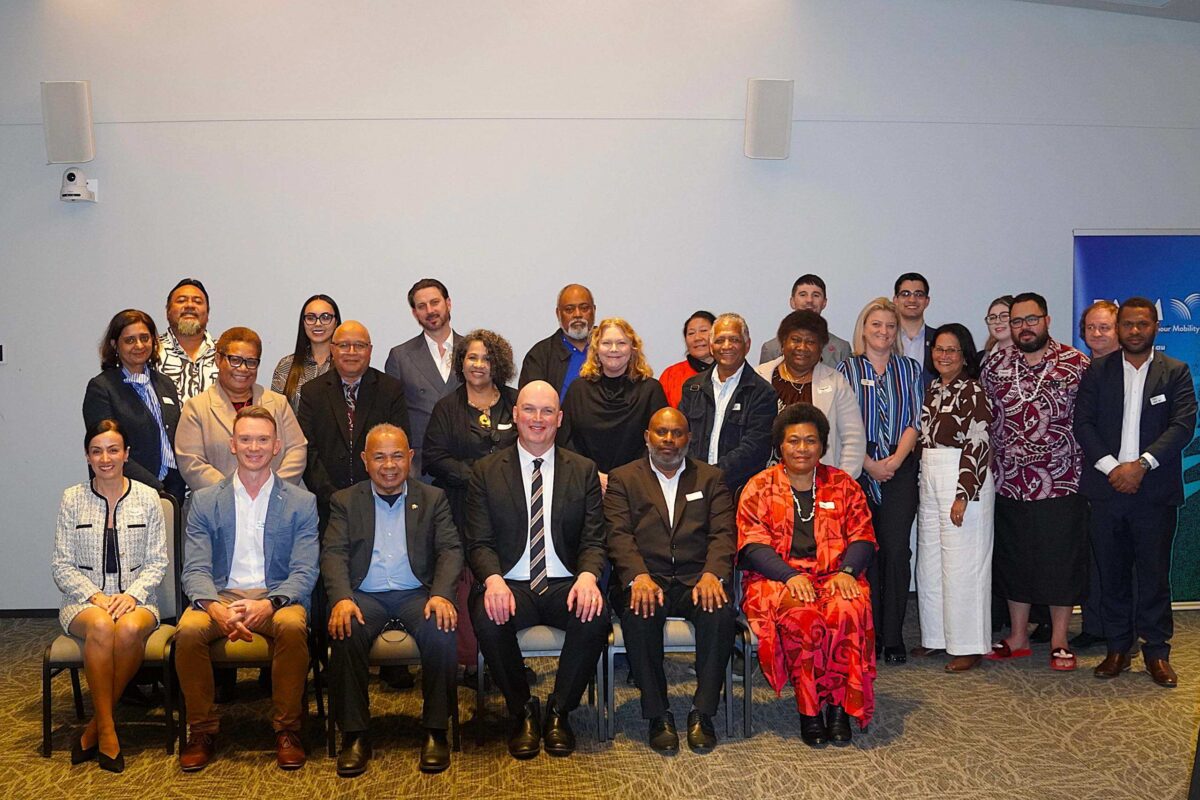
PALM Scheme Interdepartmental Disengagement Taskforce
Department of Employment and Workplace Relations, Department of Foreign Affairs and Trade, Department of Home Affairs
The PALM scheme is central to the Australian Government’s commitment to meet national labour needs, while forging stronger links with participating Pacific and Timor-Leste countries. In response to a large-scale disengagement incident, the PALM Scheme Interdepartmental Disengagement Taskforce was established. Workers may disengage from the PALM scheme for many reasons including low hours, perceived poor treatment from their employer and personal motivations. A disengaged worker no longer has access to the protections of the scheme. The Taskforce examined the incident and focused on consultations to identify six high-level recommendations that could better prevent, deter, detect and respond to disengagement.

The National Indigenous Australians Agency's Garma Program: Turning Collaboration into Impact
National Indigenous Australians Agency
The National Indigenous Australians Agency (NIAA) Garma Program is a whole-of-government leadership and collaboration initiative delivered in partnership with the Yothu Yindi Foundation. The program brings together APS Secretaries, agency heads, senior officials, First Nations leaders and partner organisations to address complex policy challenges and strengthen cross-government collaboration. In 2025, the program supported more than 100 senior leaders and officials and facilitated community visits for 19 senior delegates to Galiwinku, Gapuwiyak and Yirrkala. The program has generated enduring outcomes beyond the festival, including the SES100 leadership initiative, stronger cross-agency networks and greater adoption of place-based approaches across government.
BREAKTHROUGH CATEGORY

Successful design and implementation of Australia’s first National Lung Cancer Screening Program which launched on 1 July 2025
Australian Government – Department of Health, Disability and Ageing, National Aboriginal Community Controlled Health Organisation (NACCHO) and Cancer Australia
The National Lung Cancer Screening Program (NLCSP) is a national screening program that uses low-dose computed tomography (low-dose CT) scans to look for lung cancer in high-risk people without any symptoms. It aims to find lung cancer early and save lives.
2035 Emissions Reduction Targets Advice
Climate Change Authority
The Climate Change Authority developed independent advice on Australia’s 2035 emissions reduction target using a novel five-part method: climate science, economy-wide modelling, sector pathways analysis, stakeholder engagement and geoeconomic analysis. This rigorous approach enabled the Authority to recommend a target that balanced ambition, achievability and Australia’s national interest. The Australian Government accepted the Authority’s advice, setting a 2035 target of 62–70% below 2005 levels. The target became one part of Australia’s official climate commitment under the Paris Agreement, shaping national climate policy and signalling Australia’s pathway to net zero.

Issues and Insights – Transforming Parliamentary Research
Department of Parliamentary Services
Issues and Insights is a breakthrough initiative transforming how the Parliamentary Library delivers research through a more collaborative, strategic and user-focused model. The publication reflects a deliberate effort to think big, moving beyond legislative analysis to address fundamental challenges facing Australia and the 48th Parliament. Drawing on international perspectives, it situates national issues in a global context, highlighting policy tensions, strategic choices and emerging trends. Through innovative design, proactive topic selection and streamlined production, it delivers accessible, high-quality analysis. The initiative shifts from reactive reporting to forward-looking insight, strengthening capability and enhancing the Library’s service to Parliament.
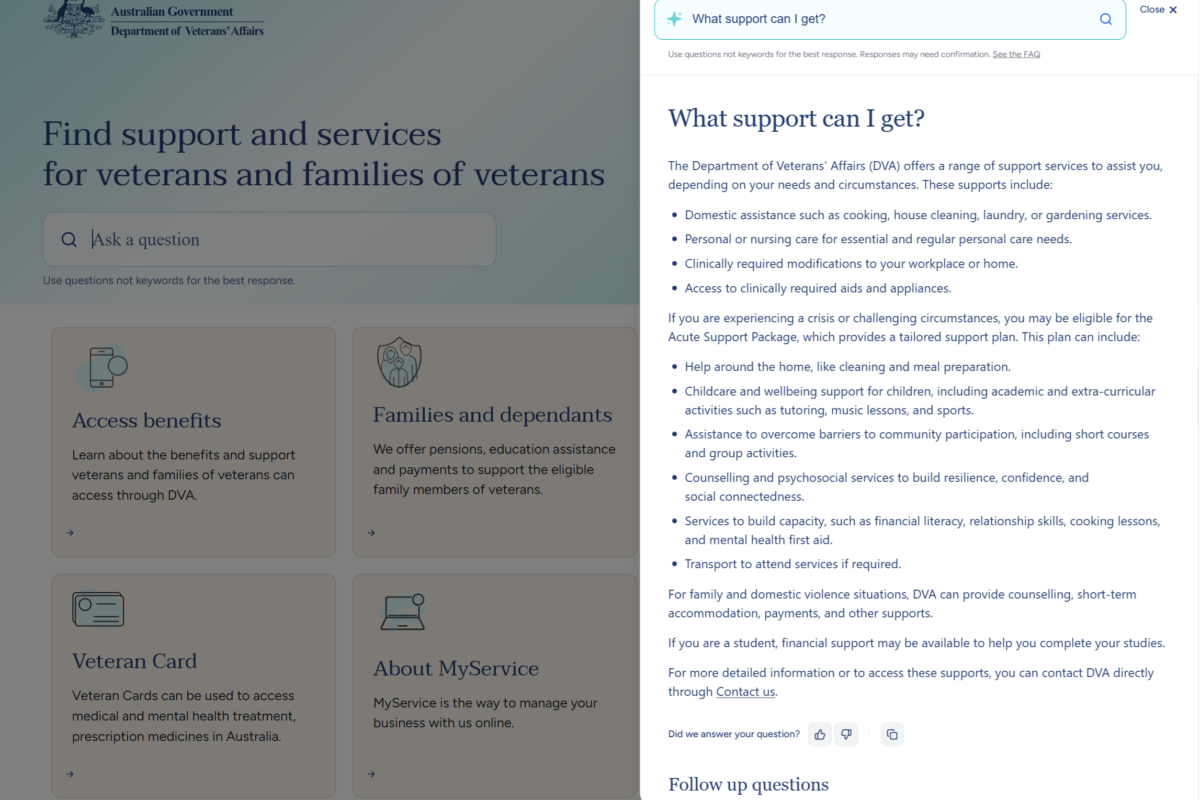
Transforming veteran access to DVA support and services with AI-powered website search
Department of Veterans’ Affairs
DVA’s AI-powered search is a breakthrough solution to one of government’s most pressing challenges: helping Australia’s most vulnerable navigate complex systems. Launched in September 2025, it’s the first of its kind deployed by an Australian Federal Government agency, demonstrating genuine service, innovation and leadership in AI. Rather than complex website navigation, veterans and families of veterans receive clear, trauma-informed answers in plain language. This initiative drives measurable positive change: 305,136 interactions in 6 months represent a 168% uplift on legacy search, across 2.22 million annual sessions. By understanding user intent and delivering practical solutions, DVA has redesigned and transformed how government serves those who’ve served Australia.

Positioning Australia: A national initiative delivering accurate, reliable positioning services across Australia and maritime regions through domestic and international partnerships
Geoscience Australia, Toitū Te Whenua – Land Information New Zealand
From landing planes safely to enabling centimeter-precision farming, high-accuracy positioning is transforming outcomes across Australia. Through the Positioning Australia Program, Geoscience Australia is delivering this capability as critical national infrastructure, accessible nationwide. Collaboration with state and territory governments, industry, New Zealand and international partners ensures consistent, scalable services across Australia. At its core, Positioning Australia broadcasts accurate positioning via satellite, or the internet, extending reliable coverage across the continent. The result is more efficient and safer operations, from precision agriculture and transport to smarter infrastructure delivery—driving productivity, reducing costs, and enabling all Australians to benefit from location-enabled technologies.
LEARNING CATEGORY

From Courses to Capability: Reimagining learning across the APS
Australian Public Service Commission
The APS Academy has reimagined capability development across the Australian Public Service through a collaborative social learning at scale approach. Through the APS Graduate Development Program, Leadership Edge and Management Edge, the Academy convenes agencies, APS practitioners, professional services partners and academic expertise to build capability through connection, reflection and real-world application. Co-designed learning experiences, including the Good Work Design sprint with Comcare and Curtin University, show how evidence, practice and peer learning can be brought together at scale. The result is a technology-enabled, practitioner-led learning ecosystem that is adaptive, human-centred and genuinely One APS.
Digital Governance Program for Senior Responsible Officials
Digital Transformation Agency
The Digital Governance Program (DGP) tackles one of government’s most critical and costly risks: even the most advanced digital investments can fail without a capable leader and a governance board with the right blend of structure, capability, culture and information flow. Designed and delivered by the Digital Transformation Agency, the DGP strengthens the capabilities of Senior Responsible Officials (SROs) leading the government’s most complex digital initiatives. Through a curated curriculum, simulations and a best-practice toolkit, the DGP is delivering decisive and confident leaders who can steer through risk, uncertainty and change, ensuring digital innovations translate into enduring value for Australians.

HEAR Training
Attorney-General’s Department
The Commonwealth Attorney-General’s Department, working with state and territory policing organisations, has developed an immersive training and education package to enhance police responses to victims and survivors of family, domestic and sexual violence (FDSV). Training content is informed by victims and survivors of FDSV and their experiences engaging with or seeking assistance from police. Training is available to police nationally in facilitated face to face, facilitated face to screen and online self-paced sessions, utilising virtual reality (VR) and 360 video to enhance adult learning outcomes while highlighting the impact of victim-centred policing.

Yarn Strong: Building Wellbeing Through Reflection, Learning and Adaptation
National Indigenous Australians Agency
Yarn Strong is the National Indigenous Australians Agency’s flagship staff wellbeing initiative, designed to strengthen psychological, social, emotional and cultural wellbeing across a geographically dispersed workforce. Built through continuous co-design with staff, Yarn Strong applies an iterative approach to learning, testing and refining wellbeing supports in response to organisational change, operational pressures and workforce feedback. Over its first year, the program engaged an estimated 1,200–1,300 staff through facilitated team sessions, reflective practice pilots, learning resources and targeted wellbeing interventions. Evidence from evaluations has directly informed program redesign, future delivery and broader organisational approaches to psychosocial risk management.


